Gentle On My Mind, 1970
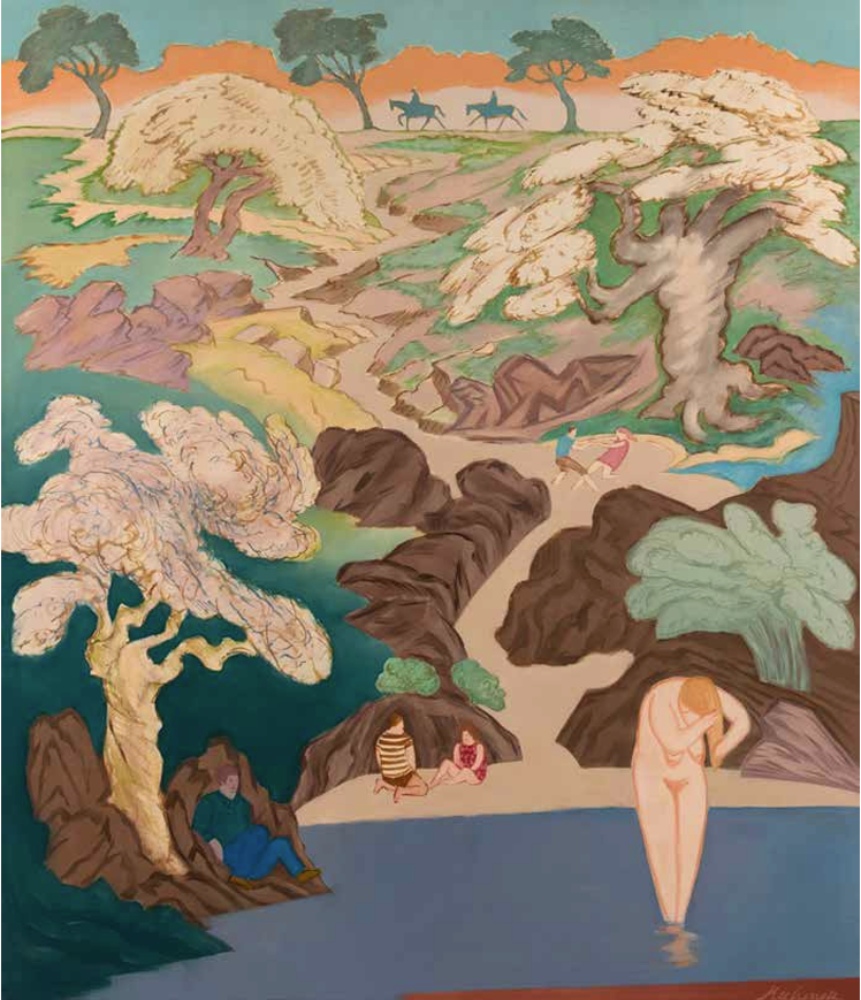
This richly hued and imposing painting stands as a “breakthrough” work for Michener. Created in 1970, after a period of experimenting with abstract figuration and other styles and subjects, it reveals the early articulation of his beliefs about living gently and harmoniously within the natural world. his reflection on Walter Quirt’s ideas about social cooperation and embracing the feminine, and his interest in melding eastern and Western cultural traditions and formal devices, begin to assert themselves here.
As well, Michener has been influenced by the idealistic premise of the Albert Camus essay, “The Rebel”, which posited the belief that art should not necessarily be “a direct reflection of the world, but rather… a model or blueprint of the artist’s desire for something more harmonious”. As a consequence, the painting is based on an idealized rather than an observed landscape. The imagery is representational but not realistic: the figures and landscape features are highly stylized, and the palette is exaggerated, its colours being both more intense and more acidic than those seen in nature.
“I want my paintings to be practical metaphors for a new way of feeling and living in the world. To achieve this, I have set aside traditional ‘realistic’ representation in favor of an imaginative transformation of the landscape motif.” Gentle On My Mind employs an up-tilted and sometimes contradictory perspective, as found in historic Asian and Middle Eastern painting, and it also borrows motifs of gnarly trees and exaggerated rock formations from these same traditions. The nude figure in the bottom right-hand corner of the composition, however, is a direct allusion to bathers in the paintings of impressionist and post impressionist artists such as Pierre Renoir and especially Paul Cézanne, and to the earlier Arcadian themes of Nicolas Poussin and Claude Lorraine. With all the figures depicted – the couples riding horses, energetically cavorting and quietly conversing, as well as the bather – there is again a sense of an idealized relationship with the natural world, of an idyll that also speaks of harmony between men and women.
Robert Michener: Natural Harmonies, Robin Laurence, Surrey Art Gallery, 2014