Artist’s Statement, 1977
The most important characteristic of all successful works of art is that they are expressive of feeling. every work of art represents a choice of certain feelings over others. It is a value choice.
In traditional cultures a large measure of the choice of feeling is made for the artist through the mode of artistic conventions. In societies such as our own, where traditions have broken down, the choice falls largely on each individual artist. Often the artist’s own choice of feeling is made intuitively — almost as if he were following instinct. Frequently the artist cannot articulate or intellectualize the process of selection even to himself. This is one major reason that the generally assumed connection between art and life remains so baffling and mysterious to most people.
A minority of artists (of which I am one) feel the need to establish a conceptual framework in which intuitive feelings can be connected to intellectual understanding of life problems. Western civilization has been shaped by conceptions which place man apart from and in opposition to the rest: of nature. These conceptions led to science and technology. They nurtured individualism and capitalism, and allowed Western man to enjoy an unprecedented degree of diversity and individual fulfillment.
Today we have come full circle. A growing minority of people around the world has perceived that mankind is on a disaster course unless it changes it’s basic conceptions and learns to live in harmony with nature rather than in opposition to nature. This is the fundamental life problem of our era. in the terms of art, I attempt to address my art to this life problem.
One can only speak in generalities about feeling and works of art which are symbols for feeling. Good works of art symbolize complexities of feeling which defy analysis and translation into language. Nevertheless, they always have some obvious characteristics which can be named and talked about. Western art has recurrent characteristics which result from the West’s conception of nature. These are evident in the form of the works — in their color, tone, texture, pattern and structure — rather than in subject matter. The true content of art work is the feelings symbolized or expressed through the formal elements.
The most important characteristic of all successful works of art is that they are expressive of feeling. every work of art represents a choice of certain feelings over others. It is a value choice.
In traditional cultures a large measure of the choice of feeling is made for the artist through the mode of artistic conventions. In societies such as our own, where traditions have broken down, the choice falls largely on each individual artist. Often the artist’s own choice of feeling is made intuitively — almost as if he were following instinct. Frequently the artist cannot articulate or intellectualize the process of selection even to himself. This is one major reason that the generally assumed connection between art and life remains so baffling and mysterious to most people.
A minority of artists (of which I am one) feel the need to establish a conceptual framework in which intuitive feelings can be connected to intellectual understanding of life problems. Western civilization has been shaped by conceptions which place man apart from and in opposition to the rest: of nature. These conceptions led to science and technology. They nurtured individualism and capitalism, and allowed Western man to enjoy an unprecedented degree of diversity and individual fulfillment.
Today we have come full circle. A growing minority of people around the world has perceived that mankind is on a disaster course unless it changes it’s
basic conceptions and learns to live in harmony with nature rather than in opposition to nature. This is the fundamental life problem of our era. in the terms of art, I attempt to address my art to this life problem.
One can only speak in generalities about feeling and works of art which are symbols for feeling. Good works of art symbolize complexities of feeling which defy analysis and translation into language. Nevertheless, they always have some obvious characteristics which can be named and talked about. Western art has recurrent characteristics which result from the West’s conception of nature. These are evident in the form of the works — in their color, tone, texture, pattern and structure — rather than in subject matter. The true content of art work is the feelings symbolized or expressed through the formal elements.
Feelings of aggressiveness strength, masculinity, control, coolness, restraint, passion, sensuousness, and drama commonly occur in Western art. This is a large range of feelings including some apparent opposites. extensive as the list is, there are some aspects of feeling which rarely occur in Western art and then usually as minor notes or else relegated to the decorative arts. Western art is seldom overtly gentle, feminine, playful or gregarious. however, if we turn to the arts of the traditional cultures of the orient, we find that the qualities largely missing from Western art predominate in Eastern art.
I believe that those felt qualities which predominate in eastern art are needed by us today. if we are to learn to relate to nature and to each other in positive
ways which will prove to be liberating for the human psyche. We must balance our aggressiveness with gentleness. instead of attempting to dominate the world outside the self, we must learn to empathize with entities outside the self. instead of defending the self, we must teach ourselves to be receptive.
Rather than imposing order on reality, we must learn to play with our world — to enter into cooperative, reciprocal relationships with it.
In my painting I am trying to create symbols for feelings of playfulness, gregariousness, gentleness and feminity without the loss of assertiveness. As a
child of my culture, for me to achieve this requires imagination and self-transcendence.
Landscape is a recurrent motif in art history because it is the motif which symbolizes man’s abiding need to comprehend nature and his relationship with the
rest of nature. in the art of painting, differing feelings in relation to nature can adequately be symbolized only through landscape painting. I paint landscapes for this reason.
The abstract expressionist painter Jackson Pollock, along with others of that art movement, symbolized in his paintings feelings of gregarity and spontaneity – but in the abstract, that is, apart from any specific relationship to the world outside his paintings. His important insight – the isolation of some of the abstract forms which symbolize gregarity and spontaneity – was a major step in the development of a gregarious art in the West. Pollock’s action painting method was
too limited to permit his knowledge of gregarious feeling to be extended into representational painting. I believe that the introjection of gregarious feeling
into relationship with the world outside the self in representational painting is the next necessary step which the abstract expressionists were unable to take. It was because I wanted to take that step that I moved away from nonrepresentational painting many years ago. For most of my artistic life my goal has been to create paintings which symbolize feelings of gregarity in a cooperative, give-and-take relationship with nature.
Landscape differs from the other basic motifs through its primary concern for space — close, middle, and distant. experience of landscape is primarily a
visual spatial experience as opposed to the more tactile and kinetic experience of interior and still-life space. objects in landscape do not generally have
the importance they have in still-life painting, nor is solidity as major a concern as it is in figure painting
When we are in the midst of nature, landscape is all around us, not just in front of us. When we are indoors looking out a window, the landscape appears to be
only in front of us and to recede from the foreground, middle ground to the distance. yet even when experiencing landscape through the proscenium of
a window, we have a very strong counter tendency not to attend to it in a logical sequence from near to far, but rather to let our attention shift randomly and
playfully between elements that occur at different distances.
The Renaissance convention of perspective is a way of representing landscape as if looking from a window, but also ordering the experience of space
so that it proceeds logically from near to middle to far. The space begins just behind the picture frame at a point already outside the observer, and continues into the distance as a reality apart from him. A separation between man – the subject and the observer – and nature – the object and the observed – is thus created and maintained. This orderly detachment evokes feelings of confidence and security and appears as a protection of the self or the subject by maintaining the other-than-self in a position of controlled distance. however, feelings of detachment may intensify into feelings of loneliness and alienation. The Renaissance formula for pictorial space masks both a fear of nature and a hostility towards her. Perhaps this is a carry over of the Christian view which equated the worldly or material with evil. As I suggested earlier, antagonistic feelings toward nature are at the root of the life problems of our time.
When one sets out to paint a landscape, one starts with a rectangular flat surface in front of one, which is not unlike standing before a window. The
hardest thing is to avoid falling into the Renaissance convention and the creation of an illusion, a symbol or representation of landscape, which starts just behind the edge of the canvas and recedes into the distance away from oneself. if this is done, feelings of separation and detachment will result.
If one is trying to convey feelings of interaction, of being part of things, of empathy with nature, one has to arrange the elements of landscape – the land,
water, sky, trees, rocks, etc., the near, middle, far – in such a way that the viewer is led to play with these same elements and to interact with them with
his intellect and his feelings. in short, the viewer must become a participant in natural processes and interact with the other actors nature’s dance.
The challenge to me in painting, then, has been to find the means to symbolize gregarious feelings in relation to landscape imagery without losing the
representational elements of landscape, and without losing what I consider to be essential in our interplay with landscape – that is, its space.
In the course of my efforts I raised horizons. I used aerial views, I warped perspectives and interjected close-up elements such as rock forms and foliage
at the top of the picture. I compressed the space. I interrupted spatial continuity with arbitrary bands of cloud forms. A few of the earlier pictures in this
exhibition still contain many such devices.
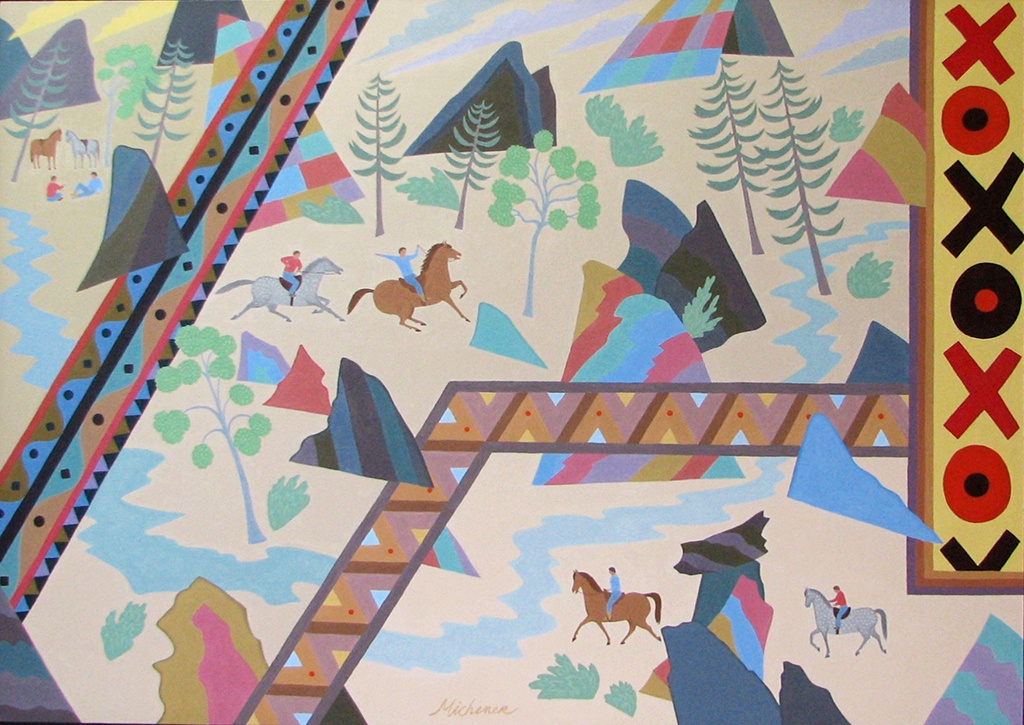
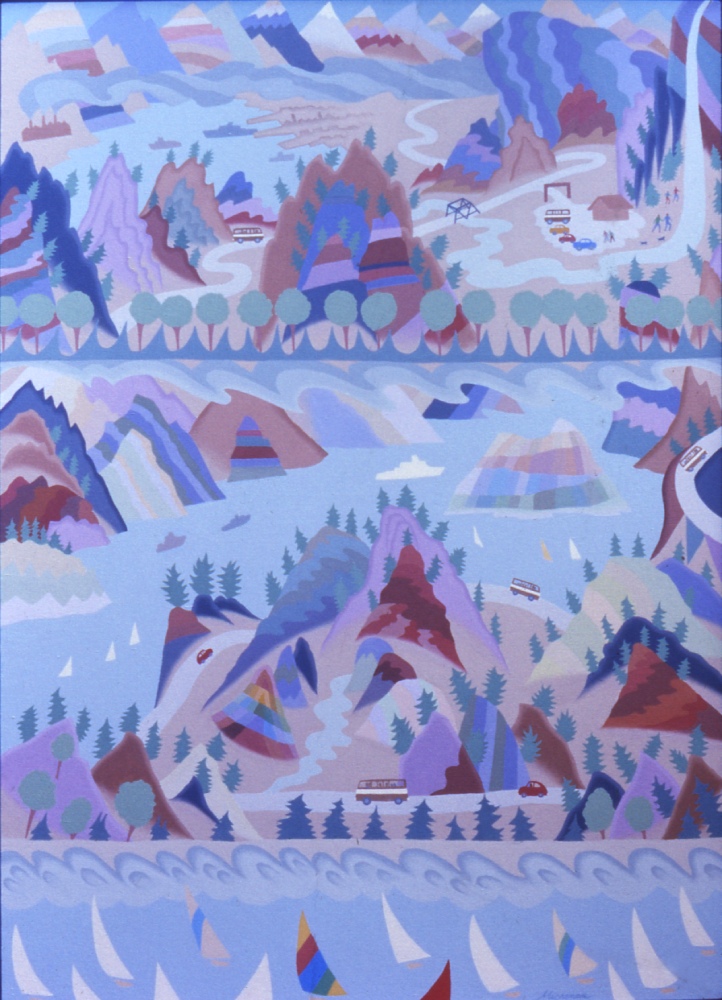
Recently I have moved farther away from representations which look like the elements of landscape, toward more symbolic representations which stand for landscape elements. There is no sharp divider between the two. The movement toward the use of symbols for mountains, rocks, trees, etc., has made it easier for me to play with the elements – to move them around arbitrarily and to be more playful in my use of colour. Sometimes I have portrayed more than one scene in the same picture so that penetration of the space at one point is contradicted by a return to the picture plane at another. I have made use of narrative in my subject matter to introject an illusion of time. I have played jokes with scale. Mountains and figures bear no relation to their actual sizes in respect to one another. Objects which read as farther away may appear larger than similar ones which are closer. Birds may appear as large as people. In my most recent pictures, I have used bands of abstract patterns to interrupt the scenes and to establish contradictory relationships on the picture plane. Throughout, two dimensional patterns and linear movements re-assert the picture plane in a kind of counterpoint opposition to the elements which create movements into and out of the picture. I have tried to avoid the literal appearance and the logic of perception which results when nature is kept at a distance, in favor of the playful perception we have of nature when we are actually in it. I have tried to identify with nature and to participate in the exuberance of natural processes.