Bio
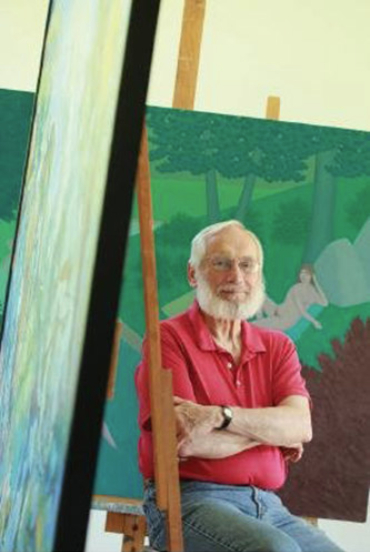
photo by Mark Mushet, Galleries West
Robert Michener was born in 1935 in rural Minnesota, and as a young boy, pursued the solitary pleasures of hiking, fishing and bird-watching among the winding waterways, towering limestone cliffs, and deep gorges near his hometown. That childhood sense of tranquil immersion in nature has informed much of his later practice. Again, the abiding wish expressed in his art is that human beings might find a “gentle” way of being in the world, one that respects and sustains the natural environment rather than plundering and destroying it. in a 2002 artist statement, Michener wrote, “i choose to paint landscape because of my boyhood intimacy with nature and because i believe that the most urgent challenge facing humanity is to discover a viable way to live with nature.”
Michener studied art at Hamline University in St. Paul, Minnesota, graduating with a BA in 1957, and earned an MFA at The University of Minnesota in 1962. An important influence during his undergraduate years was the book The Meeting of East and West by the philosopher F.S.C. Northrop, who was one of thefirst American writers to bridge eastern and Western philosophies and to describe for a Western audience the view that the world is an “undifferentiated aesthetic continuum” in which all things are connected. during Michener’s time at graduate school, he was also deeply affected by the theories of his advisor, the surrealist and later abstractionist Walter Quirt, who advocated relinquishing what he saw as the aggressive and masculine attitudes that dominated society and embracing instead a cooperative and feminine paradigm. Through Quirt, Michener became aware of the artist’s social responsibilities and a belief in art’s capacity to enact change.
Folded into Michener’s university years was a period of extensive travel through Europe and the Middle east, during which he took in as much historical art as he could. it was at this time that he first encountered Persian miniature paintings and was influenced by their compression of expression, their stylized motifs, and their up-tilted perspectives. initially, the experience of viewing the best of Western and Middle eastern art overwhelmed Michener’s sense of what he himself could produce; ultimately, it deeply enriched his art making. Through the early years of his practice, he experimented with abstract expressionism, figurative expressionism and realism.
By 1970, he had begun to consolidate his experience and beliefs into a distinctive style, often employing a flattened perspective and areas of patterning and recurring details and motifs. from this point, he embraced the landscape subject, again incorporating allusions to european Arcadian themes and Chinese literati traditions and conveying his environmental concerns.
Having taught at the Universities of Minnesota, Western Washington, and Cincinnati, Michener immigrated to Canada in 1973 to take up a position at the Vancouver School of Art (now the Emily Carr University of Art & design). Choosing to stay in Canada, he became a citizen of this country in 1978. he has exhibited extensively in Canada, the United States and europe, and his works can be found in more than 200 public, private and corporate collections, including those of the department of external Affairs, Canada, the Province of British Columbia, the Canada Council Art Bank, the Vancouver Art Gallery, and the University of Cincinnati. Michener retired from teaching, a role for which he was greatly esteemed, in 1999.
Robert Michener: Natural Harmonies
Robin Laurence, 2014
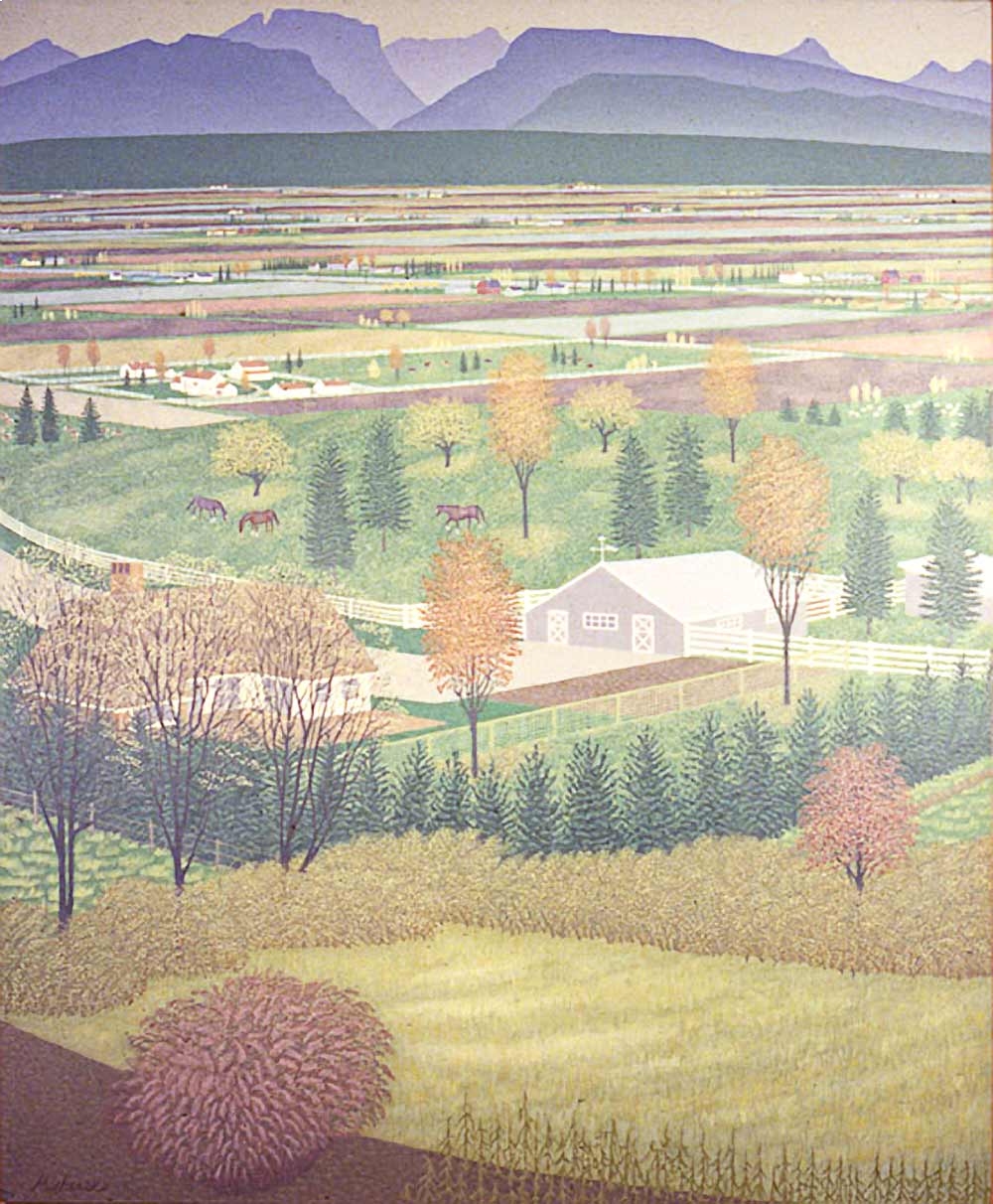
October From Our Deck
Michener’s studio and home was in Surrey, B.C., where he lived with his wife, painter Ann Nelson, and their daughter Suzanna.