Fly Fishing Mid May, 1996
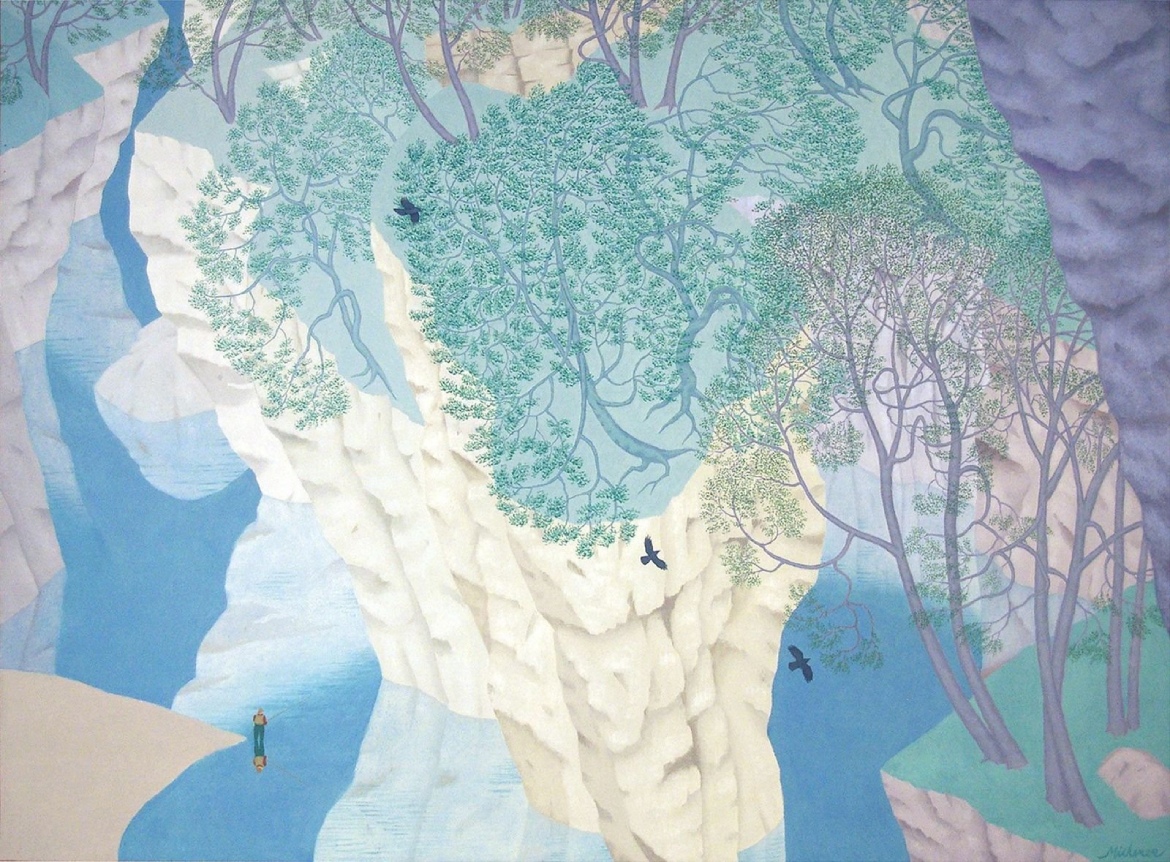
This important painting, executed in oil on linen, is part of Michener’s “Gorgeous Gorges” series, which employs childhood memories of place and purpose to create dreamy, almost edenic landscapes, viewed from above, as if by a bird or an omniscient being. drawing from his boyhood experience of fly-fishing in the Root River Valley of southeastern Minnesota, an area whose distinctive topography of limestone cliffs and deep gorges was carved out by glacial action.
Michener has again proposed a gentle and harmonious relationship between human beings and the natural world. his delicate and slightly misty palette of pale greens, buffs, blues, and taupes and his pointillist handling of foliage, rocks, and water suggest a kind of magic realism, one that enhances the meditative mood of the work. As with other paintings in this series, Michener flattens the imagery against the picture plane and manipulates the perspective, so that the overall aerial view is in some places playfully tipped and disjointed. Additionally confounding to our point-of-view are the reflections cast by the pale cliffs across the gently rippling water.
The only animals in this still and silent scene are three crows, sailing on air currents above the gorges, and the tiny figure of an angler, barely discernible among the immensity of landscape forms, standing knee-deep in water in the lower left corner of the composition. Again, Michener uses fly-fishing as a metaphor of peaceful communion with nature, while the river in which the figure stands can be seen as “a source of healing” from the wounds of contemporary urban life. The late writer and publisher Paula Gustafson noted that “Michener takes the idea of nature-as-nurturer one step further by showing the wilderness as an almost feminine environment of delicate tracery and playful illusion.”
As discussed above, Michener has drawn on a number of formal traditions found in historical Chinese landscape painting, including that of the
tiny human figure within the immense natural environment. “I [have] often placed figures in vast wilderness landscapes to suggest a view of man living as part of nature, rather than the traditional Western view which asserts man’s separateness from and supremacy over the rest of nature,” Michener
writes. here, he proposes both a reverence for life and an understanding of the interconnectedness of all life. “The lone angler symbolizes a vanishing personal and private experience with wilderness… Most fly fishers are true sportsman and practice catch and release. Unlike most other human activity in nature, this sport is not destructive to the environment.”
The sombreness of Michener’s environmental message – that we urgently need to heal our planet or witness its complete destruction – is countered in
this painting by the exquisite sense of peacefulnessit exudes.
Robert Michener: Natural Harmonies, Robin Laurence, Surrey Art Gallery, 2014